
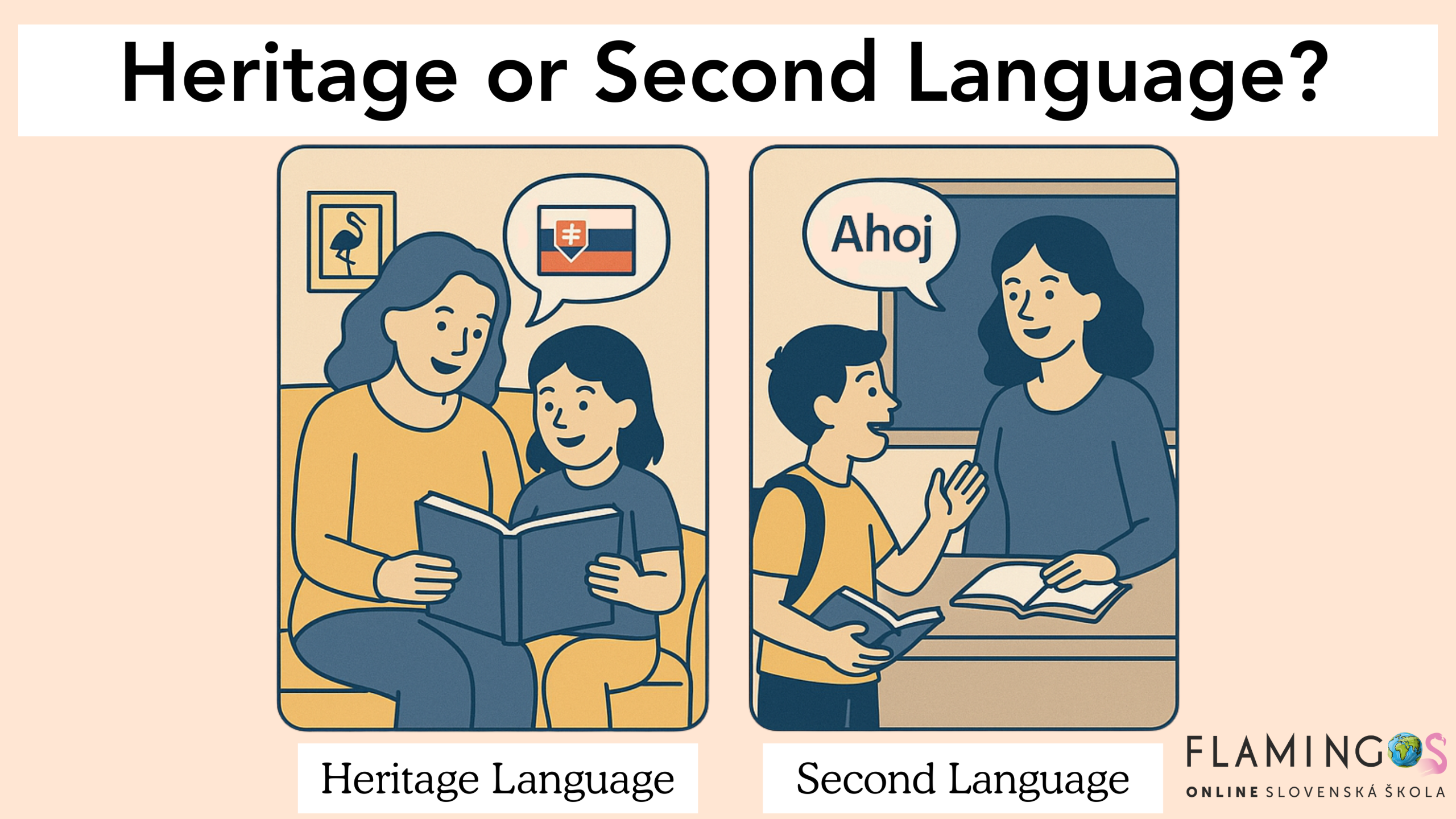
Is Your Child Learning Slovak as a Heritage Language or a Second Language? Why It Matters
At Flamingos Slovak School, we work with students across the globe who are growing up in multilingual environments. Most of our students come from Slovak families living abroad — children of Slovak parents or mixed households, raised far from home. For them, Slovak is the language of their heritage, culture, and family roots. Since they live in environments where Slovak is not the dominant language, their education falls under teaching Slovak as a language of heritage — a language passed down from parents or grandparents — rather than second language acquisition.
In contrast, Slovak as a second language is typically taught to children and adults who live in Slovakia, such as expatriate professionals or refugees, and is surrounded by Slovak daily life in schools, shops, and media.
Understanding this difference is crucial for parents and educators alike. So, how do these two learning paths differ, and how can we best support our children?
Heritage Language: A Connection to Roots in a Foreign Environment
A heritage language—or a language of heritage—is a language passed down from one’s parents, grandparents, or cultural background that is not the dominant language of the society in which the learner lives. For most Flamingos students, Slovak is spoken at home or with relatives, but not reinforced in their school or social environment.
What challenges do heritage learners face?
- They may understand Slovak well but struggle with speaking or writing.
- Exposure is limited to family conversations or weekly hours in online classes.
- Literacy and grammar often lag behind listening and comprehension.
- Their motivation is emotional: staying connected to family, culture, and identity.
Example: A Slovak family in the UK sends their children to British schools during the week. The children speak English with friends and teachers, but at home, they hear Slovak and attend Slovak classes organized by the community on weekends. While they understand a lot, their ability to write or express themselves in Slovak often needs structured support and encouragement.
Second Language: Immersion in the Majority Environment
Imagine the opposite situation: a child who moves to Slovakia from Ukraine. Although Slovak is not their heritage language, they hear it everywhere—in school, on TV, on the playground.
What makes second language learning different?
- Learners are immersed in the Slovak language and must use it to function.
- They pick up vocabulary and phrases quickly due to real-life necessity.
- Grammar is often learned intuitively, but formal correction is still needed.
- Their motivation is practical — to succeed in school, make friends, or integrate socially.
Example: A Ukrainian student starts attending a Slovak school. They speak Ukrainian at home but use Slovak with classmates and teachers all day. This real-world use accelerates fluency, especially in spoken communication.
How These Two Learning Paths Differ
| Feature | Heritage Language Learners | Second Language Learners |
| Environment | Foreign language environment | Immersed in the target language environment |
| Exposure Frequency | Limited to home and classes | Daily, widespread |
| Motivation | Emotional, cultural, familial | Practical, survival, integration |
| Skill Imbalance | Listening > Speaking > Reading/Writing | More balanced, often context-driven |
| Instruction Focus Needed | Structured grammar, literacy, and speaking | Formal correction, vocabulary expansion |
What Can Parents Do?
For Heritage Language Learners:
- Make time for the language: 2–3 short weekly sessions build consistency.
- Involve emotions: Songs, bedtime stories, jokes, or family videos in Slovak keep it meaningful.
- Encourage real use: Let your child call Slovak grandparents, write postcards, or make a scrapbook in Slovak.
- Focus on literacy: Don’t assume reading and writing will “come naturally” — they need structured teaching.
- Find local Slovak friends or families: Regular playdates or family meetings reinforce natural conversation.
- Watch Slovak movies or series: Choose age-appropriate shows and discuss them together afterward.
- Listen to Slovak podcasts: Great for older children, especially during car rides or quiet time.
- Join a book club: Starting September 1st, Flamingos will offer an online book club for older kids to discuss books and articles, building comprehension and argumentation skills.
- Use Slovak in daily routines: Write shopping lists in Slovak, play board games using Slovak terms, or label household items.
- Attend summer camps in Slovakia: Flamingos offers annual summer camps where students form lifelong friendships and experience full language immersion in a fun and supportive environment.
For Second Language Learners:
- Keep the mother tongue alive at home: Don’t abandon your first language.
- Support Slovak learning gently: Offer praise, patience, and bilingual materials.
- Be realistic: Children may mix languages — that’s part of the process.
- Celebrate progress: Every word learned is a step toward integration.
Questions to Ask Yourself as a Parent:
- Does my child hear Slovak daily outside the home?
- Are we building emotional or practical motivation?
- Are we expecting fluency too fast, or neglecting structured literacy?
Final Thoughts
Heritage language learning is about preserving identity and belonging. Second language learning is about adapting and functioning in a new society. Both require different tools, timelines, and types of encouragement.
At Flamingos Slovak School, we understand this difference. Whether your child is reconnecting with their Slovak roots or building Slovak as a new second language, we’re here to support the journey, every step of the way.
Because language isn’t just what we speak — it’s who we are.